
In Asia’s two leading financial hubs, a clear signal is coming from the market: banking clients are ready for institutions that treat artificial intelligence not as a novelty but as core infrastructure. Hong Kong and Singapore are emerging as AI‑ready financial hubs, with banks, private banks and asset managers increasingly embedding AI across retail, wealth and asset‑management workflows.
New research by MDRi, a specialist in consumer and financial‑services insights, shows that attitudes toward AI in banking are strikingly positive in both cities. In Hong Kong, 88% of respondents say they feel open or at least neutral about banks using AI; in Singapore, the figure is 83%. For financial institutions, this means that the typical client—whether a retail saver, a mass‑affluent professional or a sophisticated investor—expects AI to be part of the service. The question for banks and asset managers is no longer whether clients will accept AI, but how quickly they can turn it into visible value.
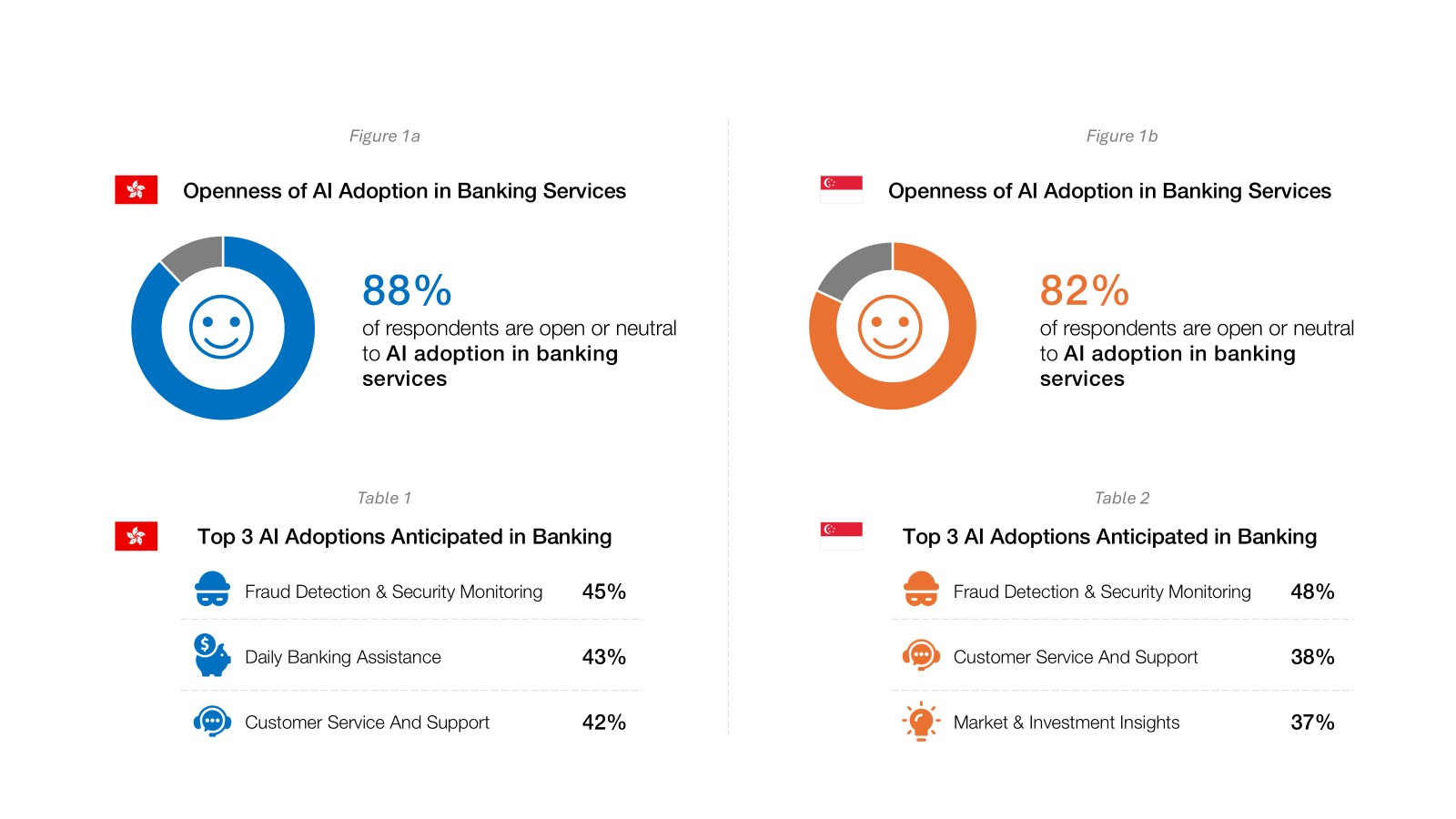
MDRi’s study also shows that clients are clear about where AI should matter most. In both markets, fraud detection comes first: in Hong Kong, 45% of respondents highlight it as the top use case, and in Singapore, 48% do the same. Against a backdrop of increasingly sophisticated scams and cyber‑crime, consumers want their banks, private banks and asset managers to spot abnormal activity in real time, across accounts and portfolios, and to intervene before losses occur. For many, an institution’s AI capabilities in security are fast becoming a proxy for trust.
Beyond safety, expectations pivot to convenience and insight. In Hong Kong, 43% of respondents say they are most excited about AI that supports daily banking—helping them manage payments, track spending and navigate complex product choices—while 42% prioritise faster, more effective customer support. In Singapore, 38% emphasise better service, and 37% highlight AI‑powered market and investment insights. For retail and mass‑affluent clients, this can mean smarter budgeting tools, timely alerts and more tailored product recommendations; for high‑net‑worth clients, it translates into continuous portfolio monitoring, sharper research and higher‑quality wealth‑growth advisory services.
On the supply side, institutions are moving quickly. Across both markets, banks, private banks and asset managers are investing in data infrastructure, analytics and model governance to respond to this AI‑ready client base. In Hong Kong, institutions are deploying or piloting AI to automate client service, streamline onboarding and KYC, strengthen risk management and accelerate credit decisions, among other uses. Singapore’s firms are increasingly weaving AI into trading, portfolio construction and back‑office operations, using algorithms to reduce friction, lower error rates and free professionals to focus on higher‑value advisory work.
For clients, the impact is starting to reshape everyday interactions. AI‑enabled assistants now handle simple queries and routine instructions, while systems running in the background flag unusual transactions, verify identities and personalise offers. In wealth and asset management, algorithms monitor portfolios continuously, surface early warnings and identify opportunities that may warrant a human conversation rather than waiting for quarterly reviews. The result is a service model that can feel more responsive, more tailored and, crucially, more secure.
The aim in both Hong Kong and Singapore, however, is augmentation, not replacement. For banks, private banks and asset managers, AI is emerging as a second engine: one that can process vast volumes of data, run complex models and keep watch around the clock, while relationship managers and portfolio managers concentrate on judgment, context and long‑term strategy. Institutions that will stand out, MDRi’s findings suggest, are those that can blend machine intelligence with human advice in a way that feels seamless and trustworthy to clients.
As Hong Kong moves from pilots to scaled deployment and Singapore embeds AI in its broader digital‑finance agenda, both centres are becoming reference points for how advanced analytics can be used responsibly in financial services. For institutions serving these markets, one conclusion is increasingly hard to avoid: a strong, visible AI offering—anchored in security, convenience and insight—is no longer optional. It is fast becoming a prerequisite for winning and keeping a savvy, AI‑ready generation of banking and investment clients.
Methodology
- MDRi conducted an online survey between 6 and 11 February 2026 among the general population in Hong Kong and Singapore, engaging a total of 1,000 respondents (500 in each market).
- The study uncovers consumers’ financial sentiment and confidence, as well as their readiness to adopt AI‑driven solutions in banking and insurance across the two markets.