In May 2025, MDRi’s China Luxury Consumer Forecast survey showed that affluent Chinese consumers were spending less on luxury and cutting back on handbags, but not on jewelry. In October 2026, LVMH’s results confirmed what they had told us in our survey.
On 12 October, LVMH reported that demand from its Chinese clients had fallen by around 15% in the third quarter. Its Fashion & Leather Goods division was down 2% for the first nine months, while jewelry delivered an “excellent” performance.1 Our May 2025 survey had already shown this pattern. More than a year before LVMH’s results, Chinese consumers told us they were spending less on luxury, cutting back sharply on handbags and protecting their spending on jewelry. This was not the first time. In every year since 2020 except 2022, our spending-intentions data has pointed to the direction of LVMH’s Asian sales before the results were published.
Here is what our data showed, how it lines up with the world’s largest luxury group, and what it means for brands and investors.
Chinese consumers’ luxury spending−10.2%LVMH Asia sales: −11.4% | Chinese consumers’ jewelry spending+53%Gold price: +56% | Plan to spend more on Chinese brands56%French brands: 45% |
Two signals: what consumers plan, and what they spend
China Luxury Consumer Forecast (CLCF) is an independent study by MDRi. It follows Chinese luxury consumers wherever they shop, at home and abroad, not just sales inside China. MDRi has run it since 2015. Each survey gives us two different signals:
Spending intentionsLOOKING AHEAD Will you spend more, the same or less on luxury in the next 12 months? The net score is the share planning to spend more minus the share planning to spend less. A rise or fall in that score tells us where the market is heading. | Actual spendingLOOKING BACK How much did you actually spend on luxury in the past 12 months, in China and abroad? The change in average spend tells us what has already happened. |
Intentions pointed the way
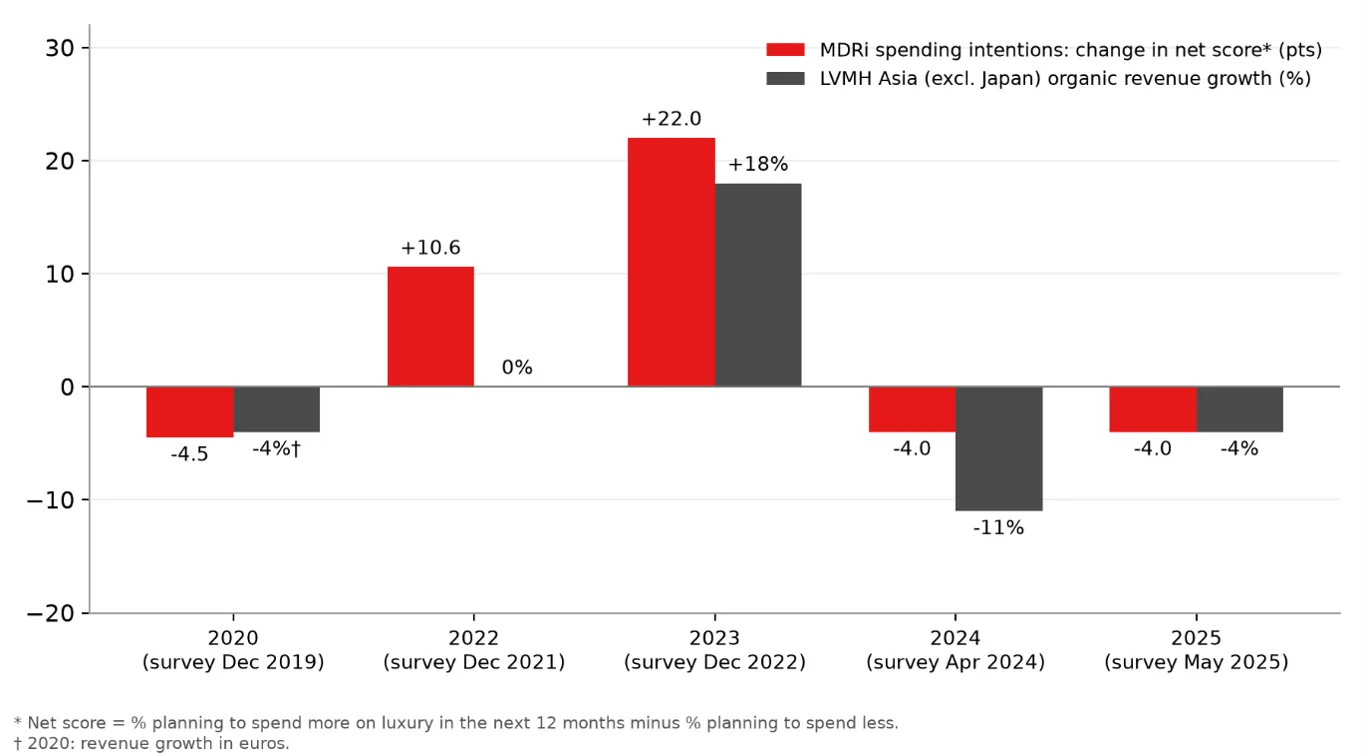
When more Chinese consumers planned to spend more, LVMH’s sales in Asia grew in the year the survey covered. When intentions weakened, sales fell. The direction matched in every year shown except 2022, when lockdowns across China held LVMH’s Asian sales flat.
Actual spending moved in step
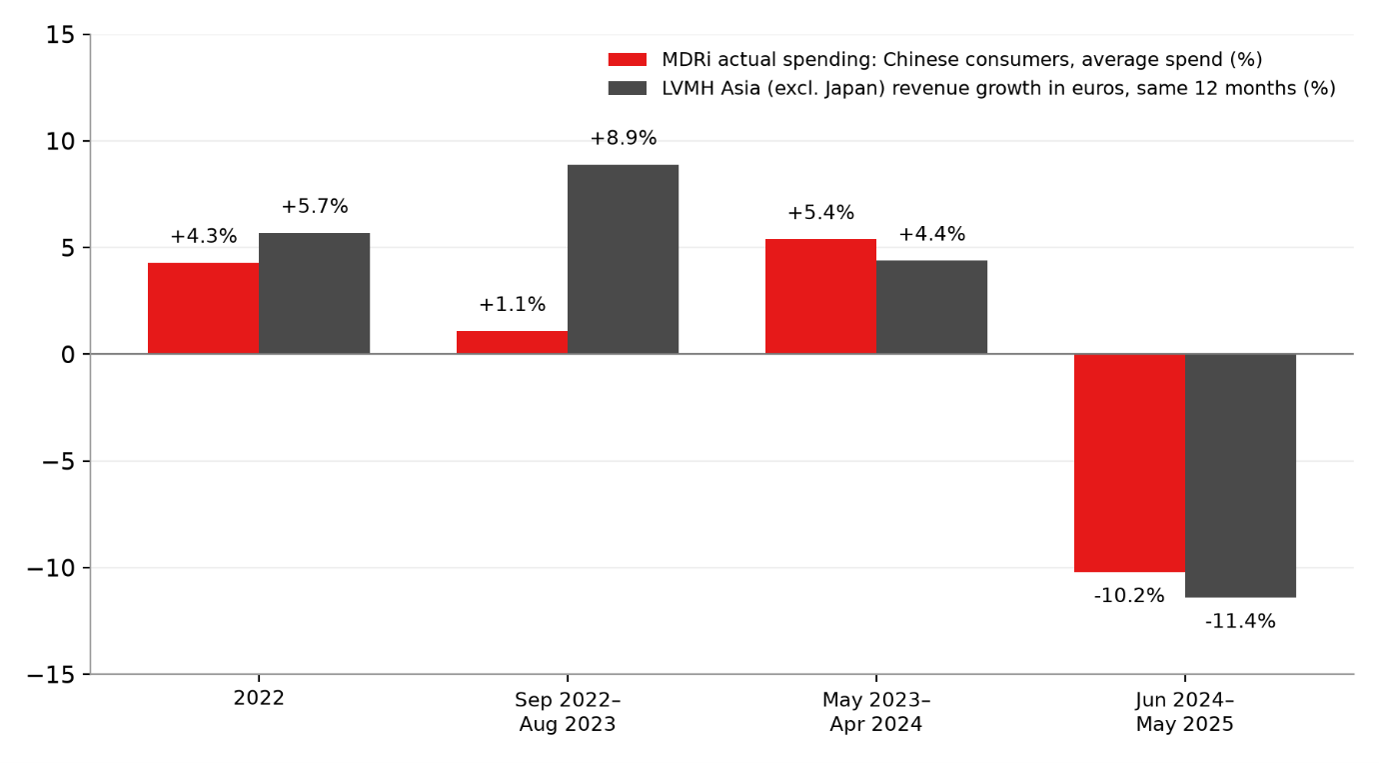
Chinese consumers’ actual luxury spending fell 10.2% in the year to May 2025. Over the same months, LVMH’s revenue in Asia fell by an estimated 11.4% in euros. The two measures moved in the same direction in every period we compared: both rose from 2022 to April 2024, and both fell in the year to May 2025.
The same trend across the luxury industry
The slowdown is not confined to LVMH. Taken together, six of the leading listed luxury groups (LVMH, Hermès, Kering, Richemont, Prada and Moncler) saw revenue stall in 2024 and fall by 2.9% in 2025.5 Hard luxury shows the same pattern: Swiss watch exports to China, a widely used indicator of watch demand, fell by 12.1% in 2025. Because these figures come from company reports and official export statistics, their consistency with CLCF’s findings is all the more significant.
LVMH’s latest results make a further point. In the third quarter of 2026, its sales in Asia fell by about 4.5%, but demand from Chinese clients fell by around 15%. Regional sales figures understate the change because they include non-Chinese customers in Asia and exclude what Chinese consumers spend abroad. To understand the Chinese consumer, you have to follow the consumer, not the region. That is what CLCF does.
Combined revenue, in euros, of LVMH, Hermès, Kering, Richemont, Prada Group and Moncler, as reported by each company. Richemont’s financial year ends in March; its figures for 2024 refer to the year to March 2025. Source: company reports.
Where Chinese consumers pulled back, sales fell. Where they spent more, sales rose.
In May 2025, MDRi’s independent China Luxury Consumer Forecast (CLCF) asked Chinese luxury consumers how much they were spending, and planning to spend, by category. The market has since moved in the same direction in each category.
| Category | Category | Chinese consumer to us, May 2025 |
| Handbags | ↓ Spending down6 | ↓ Down7 |
| Jewelry | ↑ Spending up since 20218 | ↑ Up9 |
| Watches | ↓ Fewer planning to spend more10 | ↓ Down11 |
| Travel and dining | ↑ More planning to spend12 | ↑ Up13 |
↓ Down or weaker ↑ Up or stronger
The left column shows what CLCF respondents reported in May 2025. The right column shows what company results and official statistics have recorded since. LVMH figures are organic growth, which excludes currency movements and acquisitions. Market indicators are LVMH divisional sales, Swiss watch exports to China and cross-border trips by Mainland residents.
The bigger shift: Chinese consumers are choosing Chinese brands
In our 2024 survey, Chinese brands were the first choice of Mainland luxury consumers: 33% preferred them most, against 29% for French brands. 56% planned to spend more on Chinese brands and only 7% less, the strongest result for any country of origin. French brands came next, at 45%.14
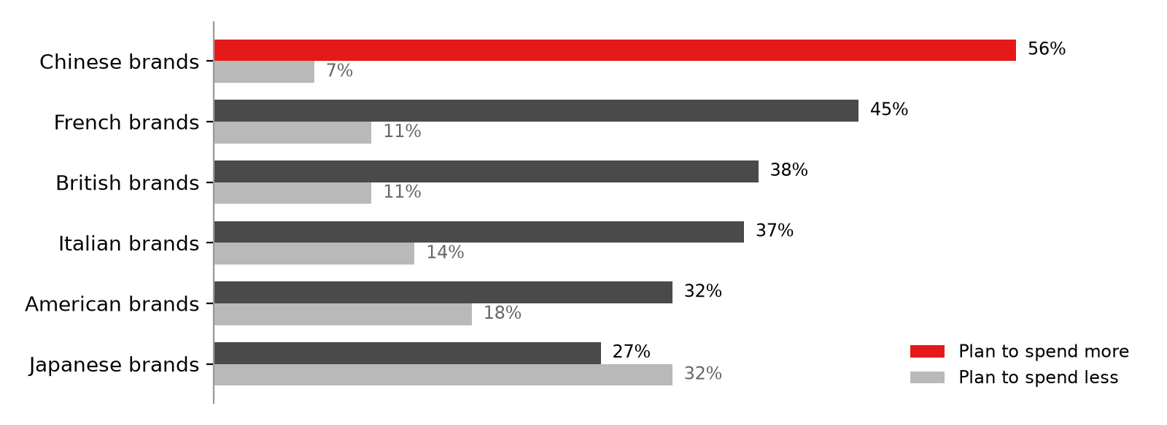
This is not trading down. The top reasons for choosing Chinese designer brands were Chinese design elements (61%), designer appeal (51%) and unique design (50%). Value for money came lower, at 42%.
Chinese consumers are spending more on jewelry, mainly because gold costs more. Between 2021 and the year to May 2025, their jewelry spending rose 53%. Over the same period, the average gold price rose 56% in US dollars.16 That suggests they are paying more per piece rather than buying many more pieces, while their total luxury spending is back where it was in 2021. Handbag spending rose to a peak in April 2024, then fell 17%.
Gold futures price in US dollars, average of monthly closes: $1,793 in 2021 vs $2,793 from June 2024 to May 2025.
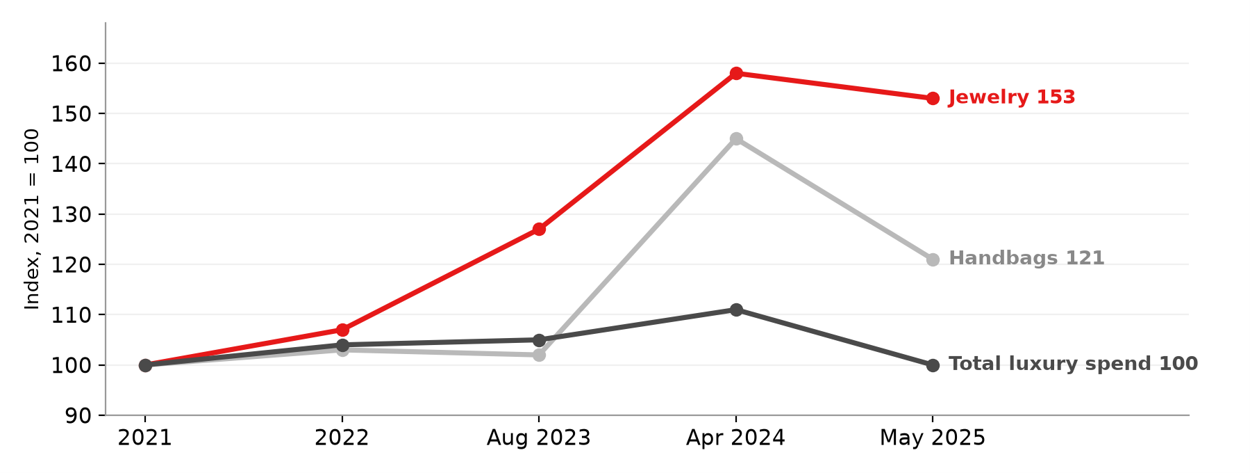
What has changed is where that money goes. Laopu Gold, a design-led Chinese heritage jeweller, grew its revenue almost sevenfold between 2021 and 2024, and tripled it again in 2025 to RMB 26.6 billion.18 Chinese consumers are not just buying gold; they are buying gold with design and meaning.
What it means
For luxury brands
- Earn cultural relevance, not just recognition. Chinese consumers are choosing design, craft and meaning, and increasingly they are finding them in Chinese brands.
- Follow the money into jewelry and experiences. Fashion, handbags and watches need a new reason to buy, not just a new price.
- Serve the Chinese consumer everywhere. They buy at home and abroad, so the experience must be consistent from Shanghai to Paris to Tokyo.
For investors
- Track the Chinese client, not the Asia line. A brand can look stable in Asia while losing Chinese customers worldwide.
- Look beneath the headline number. Within the same group, jewelry has held up far better than leather goods and watches.
- Read consumer data before company results. What consumers say they are spending often shows the direction of sales months before it appears in the accounts.
The question for international houses is no longer whether Chinese consumers will return to luxury. It is whether they will return to them.
Conclusion
Company results report what has already happened. In May 2025, Chinese consumers told us what was coming: lower luxury spending, fewer handbags, steady jewelry and a growing preference for Chinese brands. More than a year later, LVMH’s results and the wider industry figures have borne out each of those signals.
That is the value of the China Luxury Consumer Forecast. It hears from Chinese consumers directly, wherever they shop, before their decisions appear in company results.
Spending intentionsAbout the China Luxury Consumer Forecast Will you spend more, the same or less on luxury in the next 12 months? The net score is the share planning to spend more minus the share planning to spend less. A rise or fall in that score tells us where the market is heading. Contact MDRi here. |
[1] LVMH Q3 2026 revenue conference call, 12 October 2026.
[2] MDRi China Luxury Consumer Forecast (CLCF) trend data, Mainland China respondents, survey waves December 2019 to May 2025. LVMH organic revenue growth as reported by LVMH (annual results and conference calls).
[3] LVMH Asia excluding Japan: −4% (2020, revenue growth in euros, calculated by MDRi from LVMH’s group revenue and Asia’s share of it: €15,181m in 2020 vs €16,101m in 2019). Organic revenue growth as reported by LVMH: 0% (2022), +18% (2023), −11% (2024), −4% (2025). Sources: LVMH annual results press releases and presentations, 2020–2025, lvmh.com.
[4] MDRi China Luxury Consumer Forecast (CLCF) trend data, Mainland China respondents, survey waves December 2021 to May 2025; the first comparison is 2022 against 2021. LVMH Asia excluding Japan, revenue growth in euros over the same 12 months as each survey, calculated by MDRi. Asia revenue is LVMH’s group revenue multiplied by its reported share of revenue from Asia excluding Japan: €22,475m (2021) and €23,755m (2022). For the three survey periods that do not match calendar years, quarterly revenue is estimated by applying the annual Asia share to LVMH’s quarterly group revenue. LVMH reports by quarter, so each figure uses the four calendar quarters closest to the survey period. Figures include currency movements and acquisitions. Source: LVMH annual results and universal registration documents, lvmh.com.
[5] Combined revenue, in euros, of LVMH, Hermès, Kering, Richemont, Prada Group and Moncler, as reported by each company. Richemont’s financial year ends in March; its figures for 2024 refer to the year to March 2025. Source: company reports.
[6] MDRi CLCF: average spending on handbags fell 17% in the year to May 2025, from 86,600 to 72,200, compared with the year to April 2024.
[7] LVMH Fashion & Leather Goods: organic revenue −2% in the first nine months of 2026. Source: LVMH third-quarter 2026 revenue conference call, 12 October 2026.
[8] MDRi CLCF: average spending on jewelry rose 53% between 2021 and the year to May 2025, from 40,400 to 62,000. Compared with the year to April 2024, it was broadly unchanged (−3%).
[9] LVMH Watches & Jewelry: organic revenue +8% in the first nine months of 2026, with jewelry described by LVMH as recording an “excellent performance”. Source: LVMH third-quarter 2026 revenue conference call, 12 October 2026.
[10] MDRi CLCF: the share of respondents planning to spend more on watches exceeded the share planning to spend less by 28 percentage points in April 2024, and by 6 points in May 2025 (24% vs 18%).
[11] Swiss watch exports to China fell 12.1% in 2025. Source: Federation of the Swiss Watch Industry (FH), Swiss watch exports: 2025 annual statistics, published 29 January 2026. https://www.fhs.swiss/eng/2026_01_29_statistics.html
[12] MDRi CLCF, May 2025: 44% of respondents planned to spend more on travel and 8% less; average spending on fine dining rose 21% on the year to April 2024.
[13] A record 335 million cross-border trips by Mainland residents in 2025, up 15.1% on 2024. Source: National Immigration Administration of China. https://en.nia.gov.cn/n147413/c195970/content.html
[14] MDRi, China Luxury Consumer Forecast 2025 (survey April–May 2024, N = 1,500 Mainland China, 500 Hong Kong). https://mdr-i.com/wp-content/uploads/2024/11/china-luxury-consumer-forecast-2025-report-9336d62f70f05b1786a0ba9471f59c86.pdf
[15] MDRi, China Luxury Consumer Forecast 2025 (survey April–May 2024, N = 1,500 Mainland China, 500 Hong Kong). https://mdr-i.com/wp-content/uploads/2024/11/china-luxury-consumer-forecast-2025-report-9336d62f70f05b1786a0ba9471f59c86.pdf
[16] Gold futures price in US dollars, average of monthly closes: $1,793 in 2021 vs $2,793 from June 2024 to May 2025.
[17] MDRi China Luxury Consumer Forecast (CLCF) trend data, Mainland China respondents, survey waves December 2019 to May 2025.
[18] Laopu Gold Co., Ltd. (6181.HK), revenue RMB 1.26bn (2021), 8.51bn (2024), 26.6bn (2025).
Notes on the data
- All CLCF figures are for Mainland China respondents.
- LVMH Asia is Asia excluding Japan. In the first chart, LVMH figures are organic growth, which excludes currency movements and acquisitions; the exception is 2020, which shows revenue growth in euros. In the second chart, LVMH Asia figures are revenue growth in euros, calculated by MDRi from LVMH’s reported revenue and its share of revenue from Asia.
- Spending intentions: each survey wave (December 2019, December 2021, December 2022, April 2024 and May 2025) is compared with the year it covered.